
Creating different levels of engagement in a community project
When we set out to build the Good Neighbourhood Project, we knew not everyone would be able to commit in the same way. Some people are up for weekly meetings and organising duties. Others might just want to pop by a festival or fill out a quick survey. And that’s okay, in fact, it’s necessary. If we want community engagement to be genuinely inclusive, we need to design for different capacities, comfort levels, and points of entry.
We created a layered engagement mode, from quick, low-pressure interactions to deeper, long-term involvement. This approach helped us reach a broader cross-section of the community and allowed people to shape their involvement in ways that worked for them.
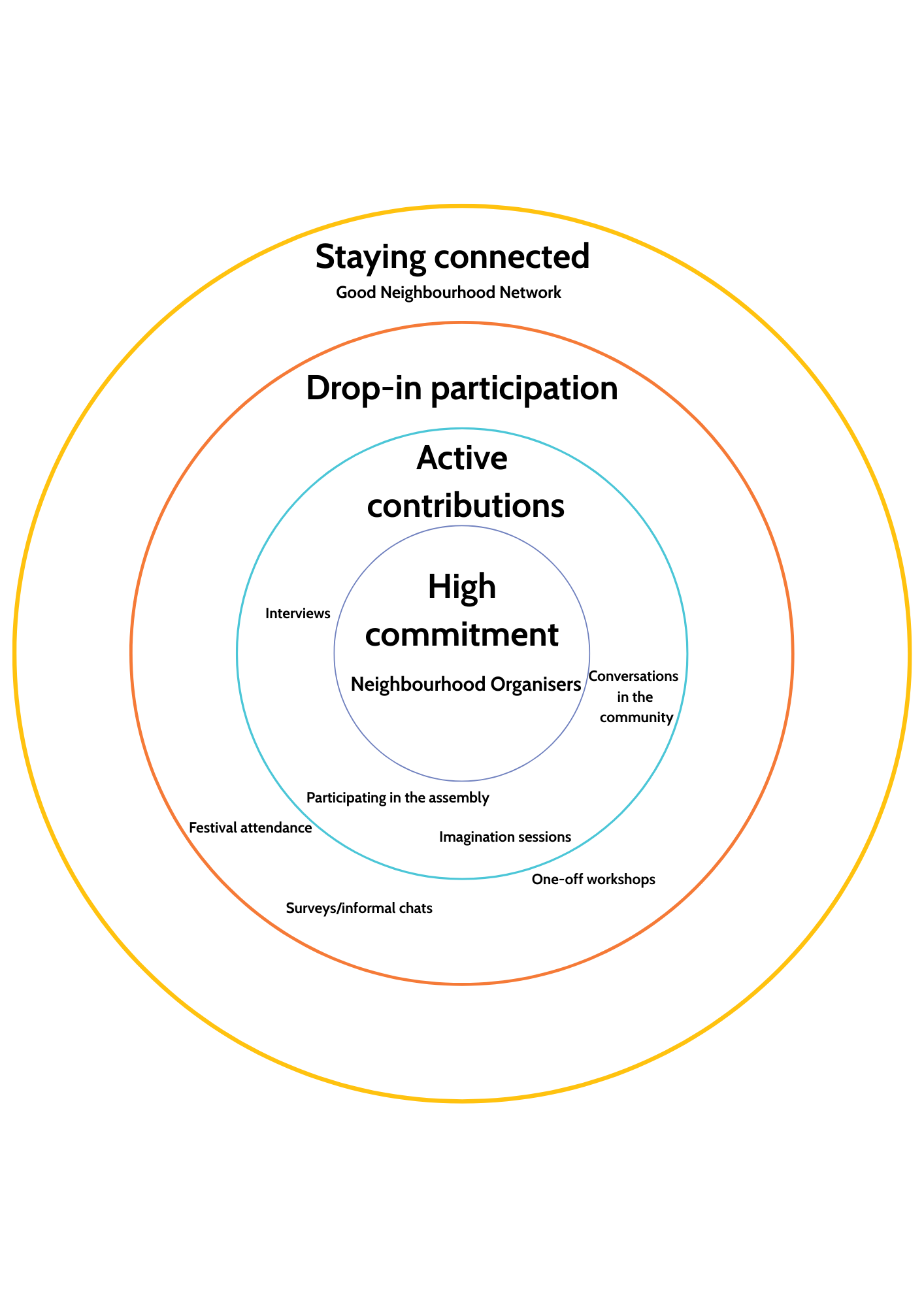
From the outset, we structured the Good Neighbourhood Project to include a spectrum of opportunities, ranging from light-touch, one-off activities to deeper, long-term roles. This included:
Imagination Workshops
Community Engagement Tools (surveys, interviews, informal chats)
The Good Neighbourhood Network
The Good Neighbourhood Festival
Neighbourhood Organisers in the Good Neighbourhood Collective
The Good Neighbourhood Assembly
Each option was designed with different capacities in mind, helping us to scale participation beyond the core organiser group and build a wider sense of shared ownership over the project.
In the early stages of the project, we ran a series of imagination workshops designed to tap into local hopes, concerns, and ideas for the neighbourhood. These 90-minute sessions were tailored to the groups we worked with, including children at The Winch’s playgroup and older adults through the Kilburn Older Voices Exchange. These sessions were low-barrier, creative, and fun, and ensured community input from the get go.
We recognised the importance of informal social gatherings in building trust and visibility. The Good Neighbourhood Festival was our first public event, drawing around 300 people to the Swiss Cottage Open Space. It combined creative activities, food, informal networking, and connections with local organisations. This relaxed setting gave people a chance to engage on their own terms and lowered the pressure of ‘having to contribute’ in a formal way.
For those who wanted to play a more active role, we offered the opportunity to become a Neighbourhood Organiser. This involved a significant time commitment, which ran over four months and included weekly meetings. Organisers played a vital role in going out into the community to gather insights through interviews, surveys, street conversations, and community stalls, collecting both in depth and light touch data whilst broadening the project's reach.
We were mindful that decisions shouldn’t just rest with a core group. To broaden input, we held a Good Neighbourhood Assembly, where community members could vote on the organisers’ recommendations. Around 50 people attended, adding democratic legitimacy and deeper community buy-in to the outcomes. To extend participation further, we also held an online vote, reaching an additional 100 people who couldn’t attend the event. There was some debate about whether to prioritise more informed responses from those who had engaged directly with the proposals or to open up the process to a wider audience. In the end, the neighbourhood organisers agreed that broadening our reach was more valuable.
Not everyone is able to participate actively. For those who preferred to stay informed and attend occasional events, we launched the Good Neighbourhood Network: a mailing list for updates, invites, and occasional opportunities. This allowed us to maintain a broad base of support and awareness.
Designing multiple engagement levels meant that people could dip in and out as their availability or interest changed over time. It also allowed us to layer involvement; someone might start at a festival, later join the mailing list, and eventually become a Neighbourhood Organiser. Ultimately, the flexibility in engagement was key to creating a neighbourhood project that felt responsive to and representative of the community.